Definition of Syllogism
What is the meaning of syllogism ?The word syllogism is derived from a Greek word ‘syllogismos’ means "conclusion, inference" .Syllogism is a kind of logical argument that applies deductive reasoning to arrive at a conclusion based on two or more propositions that are assumed to be true.
How to solve Syllogism for competitive exams?
Almost every competitive exams or aptitude test included syllogism questions. Syllogism reasoning questions are asked all banking,SSC,RRB,UPSC exams. Most of the candidates find "syllogism " bit confusing. But this is one of the section from which you can easily score without much effort. Once you understand the concept of syllogism thoroughly there will be no place for confusion. Here we are discussing syllogism tricks & syllogism rules for solving questions faster. Three ways you can solve syllogism questions depending on the type and complexity of questions asked.- Cross cancellation and vertical cancellation.
- Immediate inference(Deduction of conclusion from a single statement).
- Venn diagram method.
Cross cancellation and vertical cancellation
These two methods are extremely simple, but not effective in complex questions. You can use this method for solving "direct and simple syllogism questions".
Following are the main rules for solving Syllogism Problems :
1. All + All=All
2. All + No=No
3. All + Some=No Conclusion
4. Some + No= Some Not
5. Some + All=Some
6. Some + Some= No Conclusion
7. No + Some=Some Not (Reversed)
8. No + All = Some Not(Reversed)
9. No + No=No Conclusion
10. Some Not /Some Not Reversed + Anything = No Conclusion
Following are the main rules for solving Syllogism Problems :
1. All + All=All
2. All + No=No
3. All + Some=No Conclusion
4. Some + No= Some Not
5. Some + All=Some
6. Some + Some= No Conclusion
7. No + Some=Some Not (Reversed)
8. No + All = Some Not(Reversed)
9. No + No=No Conclusion
10. Some Not /Some Not Reversed + Anything = No Conclusion
Solving two statement syllogism using Cross cancellation method
Example1:Statements:All maps are roads, Some roads are cities.
To deduce relation between maps and cities you can use cross cancellation.

Strike out common term “roads”. What is left? “All maps are” and “Some are cities”. From above table All + Some=No conclusion.So , no specific relation between roads and cities can be drawn from above statements.To deduce relation between maps and cities you can use cross cancellation.

Example2:No pencil is a chair,All pens are pencils
Reverse the order of statement for simplicity,
All pens are pencils
No pencil is a chair

Strike out common term pencil. All+No=NO.So, relation between pen and chair is “No pen is a chair”
Example3: No bag is a computer,Some computers are ice-cream

Strike out common term computer.
NO+Some=Some not(reversed)
So, relation between bag and ice-cream is “Some ice-cream are not bags”.
Cross cancellation method for three statement syllogism
Example.Some mangoes are apples,All apples are oranges,All oranges are pineapple.

Strike out common term from first and second statements.Example.Some mangoes are apples,All apples are oranges,All oranges are pineapple.

Strike out common term from second and third statements also.
From first and second statements Some + All = Some
Add this result to next, ie Some+All=Some
So, relation between mangoes and pineapples is “Some mangoes are pineapples”
Vertical cancellation method to solve syllogism
Example.No car is a bike,Some buses are bike.Here in this set of statements , there is no scope for cross cancellation. When you find questions like this, go for vertical cancellation method.

Strike out common term “bike”.
No + Some=Some Not (Reversed)
Thus , relation between car and buses is “Some buses are not car”.
Immediate inference(Deduction of conclusion from a single statement)
In some cases you can deduce conclusion from a single statement. Such cases are tabulated below.
Statement
|
Conclusion
(Immediate inference)
|
All A are B
|
Some A are B, Some B are A
|
Some A are B
|
Some B are A
|
No A is B
|
No B is A
|
Two statements Syllogism Practice questions with answers.
In each of the following questions below are given two statements followed by two conclusions .You have to take given statement to be true even if they seem to be at variance with commonly known facts. Read all the conclusions and then decide which of the given conclusions logically follows from the given statements disregarding commonly known facts.
Give answera)If only conclusion I is true
b) If only conclusion II is true
c) If either I or II is true
d) If neither I nor II is true
e) If both are true
Questions
1.Statements:All nails are ears, Some ears are eyes
Conclusions:I.All ears are nails , II.Some eyes are nails
2.Statements:All books are shrubs, All trees are shrubs
Conclusions:I.Some shrubs are books, II.Some shrubs are trees
3.Statements:Some books are birds, Some bird are fingers
Conclusions:I.Some fingers are books, II.Some finger are birds
4.Statements:All dogs are monkeys, No monkey is cat
Conclusions:I.No dog is a cat, II.No cat is a dog
5.Statements:Some phones are watches, All watches are guns
Conclusions: I.All guns are watches, II.Some guns are phones
Answers:1.d, 2.e, 3.b, 4.e, 5.b
Solving Syllogism possibility questions using Venn diagram
This method is suitable for solving 3,4 or 5 statement syllogism .Before solving questions ,let us understand Venn diagram for possible statements.
1.Statement:”All A are B”
Possible Venn diagrams.
 |
| fig1 |
 |
| fig2 |

You can see only conclusions 2 and 3 clearly follows .But look at the conclusions 1 and 7,there is a possibility for these conclusions to be true. If the conclusions 1 and 7 are modified as below
1=> All A being B is a possibility(see fig.2). and
7=> Some B not being A is a possibility (see fig.1).
Then the answer will be’ YES’ and ‘YES’. Hope it is clear….Now let us go to next statement
2.Statement:”some A are B”
Possible Venn diagrams.
 |
| fig3 |
 |
| fig4 |
 |
| fig5 |
 |
| fig6 |

You can see only conclusion 3 clearly follows. But in some cases there is possibility for conclusions 1,2,6 and 7 to be true. If we modify 1,2,6 and 7 as follows.
1=> All A being B is a possibility.(see fig.4 and fig.6)
2=>All B being A is a possibility.(see fig.5 and fig.6)
6=>Some A not being B is a possibility(see fig.3 and fig.5)
7=>Some B not being A is a possibility(see fig.3 and fig.4)
Then these conclusions follows the statement.
3.Statement:"Some A are not B"
Possible Venn diagrams.
 |
| fig7 |
 |
| fig8 |
 |
| fig9 |

None of the conclusion follows directly. But there exist possibility for conclusion 2 to 7.If we modify them
2=>All B being A is a possibility? YES (fig.8)
3=>Some B being A is a possibility? YES(fig.7 and fig.8)
4=>No A being B is a possibility ?YES(fig.9).
5=> No B being A is a possibility ?YES (fig.9).
6=> Some A being B is possibility?YES(fig.7 and fig.8).
7=> Some B not being A is a possibility.?YES(fig.7 and fig.9).
Hope you understood ….
4.Statement:"No A is B"
Possible Venn diagram
 |
| fig10 |

Conclusions 4,5 and 7 follows. In this case there is only one Venn diagram possible ,therefore there is no possibility cases.
Now let us do some simple problems.
Q1)Statement :Some Pens are Pencils.
All Pencils are Books.
Conclusions:1.All the Books are Pencil
2. Some Pens are Book.
3. All Pen being Book is a possibility.
or


Ans:1-NO,2-YES,3-YES.
Q2)Statement:Some Dogs are Cat.
Some Cats are Cows.
Conclusions:1.Some Dogs are Cows.
2. Some Cats are Dogs.

or

ANS:1-NO,2-YES
Q3):Statements:All cars are Chair.
No Chair is Mug.
Conclusions:1.No car is mug.
2.All Chair are cars.

ANS:1-YES,2-NO
3,4 statement Syllogism practice questions
Q1.Statements
1.All Watches are Keys
2.All Keys are Cats
3.Some Bats are Cats
Conclusions:
1.Some Cats are watches
2.All Keys are Watches
3.Some Bats are watches
4.Some Bats being Key is a possibility.
Options :
1.All 4 conclusions are true
2.Only 1 and 4 follows
3.only 2 and 3 follows
4.none of the conclusions follows

ANS:2
Explanation:
Look at conclusions 1,2 and 3 .From fig.1 itself, you can conclude whether these conclusions are valid or not. But conclusion 4 is a possibility case. In such cases ,we have to find out whether ‘any such diagram exist where this conclusion is valid’. We know that number of diagrams are possible for a statement. So, many diagrams can be drawn for a set of statements. Modify Fig.1, incorporating possibility case(Some Bats being Key is a possibility) to get fig.2 .You can see none of the statement is violated in fig.2. So conclusion 4 holds true.
Q2.Statements
1.Some Lions are Tables
2.All Benches are tables.
3.Some Tigers are Benches
4.Some Chairs are not Tigers
Conclusions:
1.Some Benches are Tigers
2.Some Lions are Tigers
3.Some Chairs are not Benches
4.Some Tigers are tables
5.All Chair being Table is a Possibility.
Options:
1.only 1,2,4 and 5 are true .
2.only 1,4and 5 are true.
3.Only 1,2,3 and 4 are true.
4.none of the above.
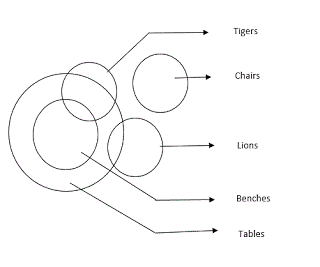
Modified diagram (incorporating possibility conclusion in above diagram).

ANS:2
Q3.Statement:
1.All Trees are Fruits
2.All Fruits are vegetables
3.No Vegetable is Sweet.
Conclusion
1.No Fruit is Sweet
2.All Vegetables are Fruits
3.Some Sweets are Fruits
4.No Vegetable is Tree.
Options :
1.only 1 is true
2.All are true
3.Only 1 and 4 are true
4.Only 2 and 3 are true

ANS:1
Those who want Syllogism sample questions with answer pdf may contact us through contact form given below. If you find this Syllogism questions and answers shortcuts tricks and methods useful don't hesitate to like and share.